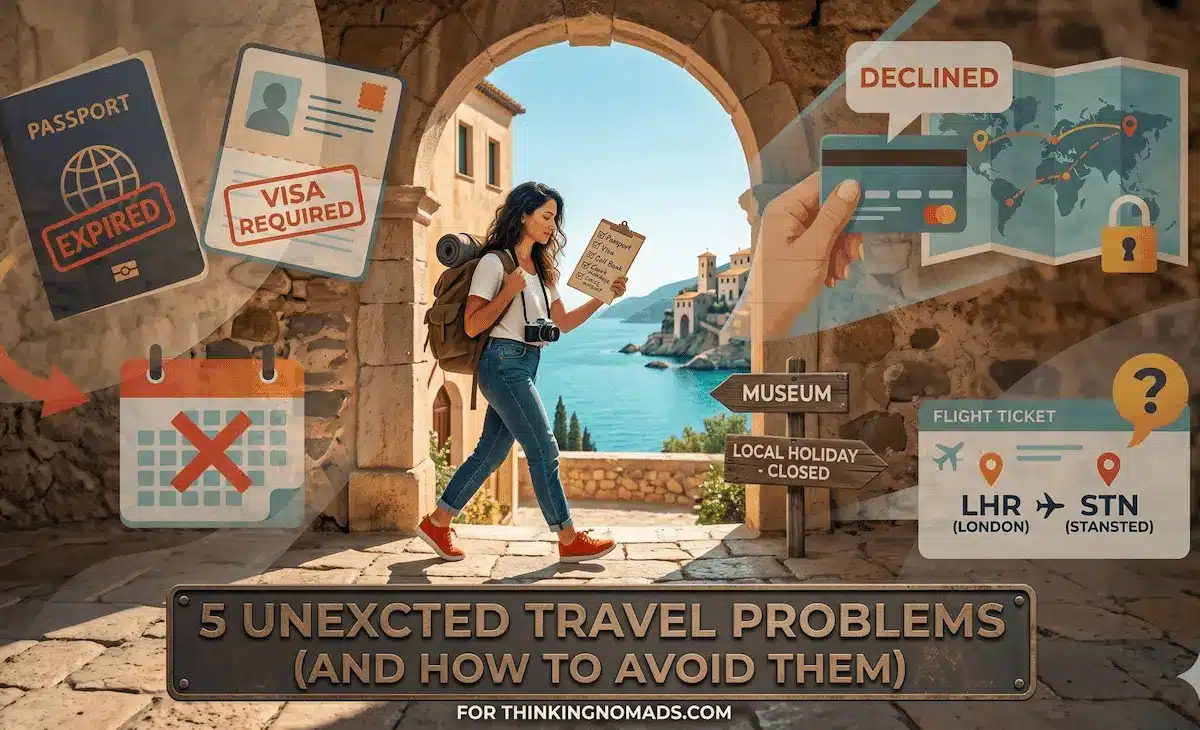
Ask any frequent traveler what their worst trip taught them and you’ll typically get the same answer: it’s always the one thing you didn’t think to check.
Maybe it’s your bank trying to be the good guy and freezing your card on day one of a three-month journey. Maybe it’s a lost passport or stolen passport (the worst). Or, perhaps you booked your tickets to the right city… but the completely wrong airport.
These small issues might seem random, but they can quickly turn your idyllic adventure into a stress-filled mess. In this article, we’ll cover 5 unexpected travel problems travelers or digital nomads often run into, and how to avoid them so your trip goes smoothly.
Having an Expired Passport
You’ve found the perfect tickets, your cursor is already hovering over the ‘Buy’ button, and the only thing that’s left is to fill in your traveler details…
But wait, what’s that? Is that an expired passport? An expired (or nearly expired) passport is one of the most frustrating travel problems because it can derail your plans before you even leave. In fact, most countries require your passport to be valid for at least 3 to 6 months after entry.
What makes it worse is how easy it is to miss. It’s not something you check often, so it’s usually the last thing you think about until you actually need it. And by then, you’re already mid-booking or counting down to your trip.
The only way to avoid this problem is to check your passport early and make sure you have plenty of “buffer time” before it expires. I also recommend to read my post How to keep your passport safe while abroad on this matter.
Needing a Visa
This is the kind of problem that seems too obvious to miss, and yet, it happens all the time.
Case in point: one of my friends planned a trip to Brazil for Carnival and had everything booked — the hotels, the airline tickets, even an airport transfer. Everything was perfect. That is, until he found out US citizens needed a visa to enter Brazil.
It’s an easy mistake to make, especially if you’ve traveled a lot and are used to visa-free entry.
To avoid this, look at visa requirements as soon as you pick a destination. For most countries, you can find the information on the consulate’s website or with a quick check on Wikipedia.
It’s also worth researching whether you need anything beyond a visa, like proof of onward travel, accommodation details, or a certain amount of validity left on your passport, since these are the kinds of things that tend to catch people off guard at check-in or immigration.
The Bank Freezes Your Card
Imagine arriving in a new country, spotting a cute cafe, swiping your card… and it’s declined. You try again. Declined. Congratulations, your bank thinks your vacation is suspicious.
This is one of the most irritating travel problems because, technically, the bank is doing its job and “looking out for you.” In reality, you’re just standing in a foreign city without access to your money, trying not to stand there awkwardly while a queue forms behind you.
Any unusual overseas transaction can trigger a freeze, especially if you didn’t notify the bank or rarely pay abroad. Interestingly, a survey noted that 77% of travelers whose cards were blocked overseas hadn’t informed their bank in advance.
To avoid this, be sure to notify your bank before traveling. For extra safety, carry a backup card and some cash, and keep them separate from your main wallet in case something gets lost or blocked at the worst possible moment.
Arriving During a Local Holiday and Everything’s Closed
Travel guidebooks love to highlight local festivals, holidays, and cultural events. After all, who doesn’t love the idea of experiencing a destination at its liveliest?
But they rarely mention the downside: sometimes the city shuts down. Stores, pharmacies, and museums are closed, public transport may run on strange schedules, and your sightseeing plans crumble right before your eyes.
While it might seem harmless compared to an expired passport or missing visa, it’s still an unpleasant little quirk that can throw your whole trip off.
Before you go, look beyond the usual basics and check what’s happening locally, especially public holidays and major events. We particularly like OfficeHolidays, which has a helpful calendar of public holidays, what’s being celebrated, and whether places are closed.
Booking the Wrong Airport
It’s surprisingly easy to book the “right” city and still end up in the wrong place. Many major destinations have multiple airports, and the differences between them aren’t always obvious at the time of booking.
Take Istanbul. It’s easy to assume all flights land at the main “Istanbul Airport,” but some routes arrive at Sabiha Gokcen Airport on the Asian side, which can add a significant transfer depending on where you’re staying.
London is an even better example because it has five airports. Yes, you read that right, five. And they’re not just different terminals, they’re in completely different parts of the region.
If you land at Heathrow, you’re relatively close to the city center and can get to London in about 45 to 60 minutes by train or metro. However, if you land at Stansted, you’re much farther out. Getting into the city can take around two hours by train, and that’s before you even get from the station to your hotel. And if you are in London, check out my guide London on a Budget: How to Experience the City Without Breaking the Bank.
Although this mistake rarely ruins a trip, it’ll cost you time, energy, and test your patience a bit. On the plus side, it makes a great story — though it’s always better to read stories like this than experience them yourself.

Lived in England since 1998 and travelled the world since 2005, visiting over 100 countries on 5 continents. Writer, blogger, photographer with a passion for adventure and travel, discovering those off beat places not yet on the tourist trail. Marco contributes the very best in independent travel tips and lifestyle articles.
