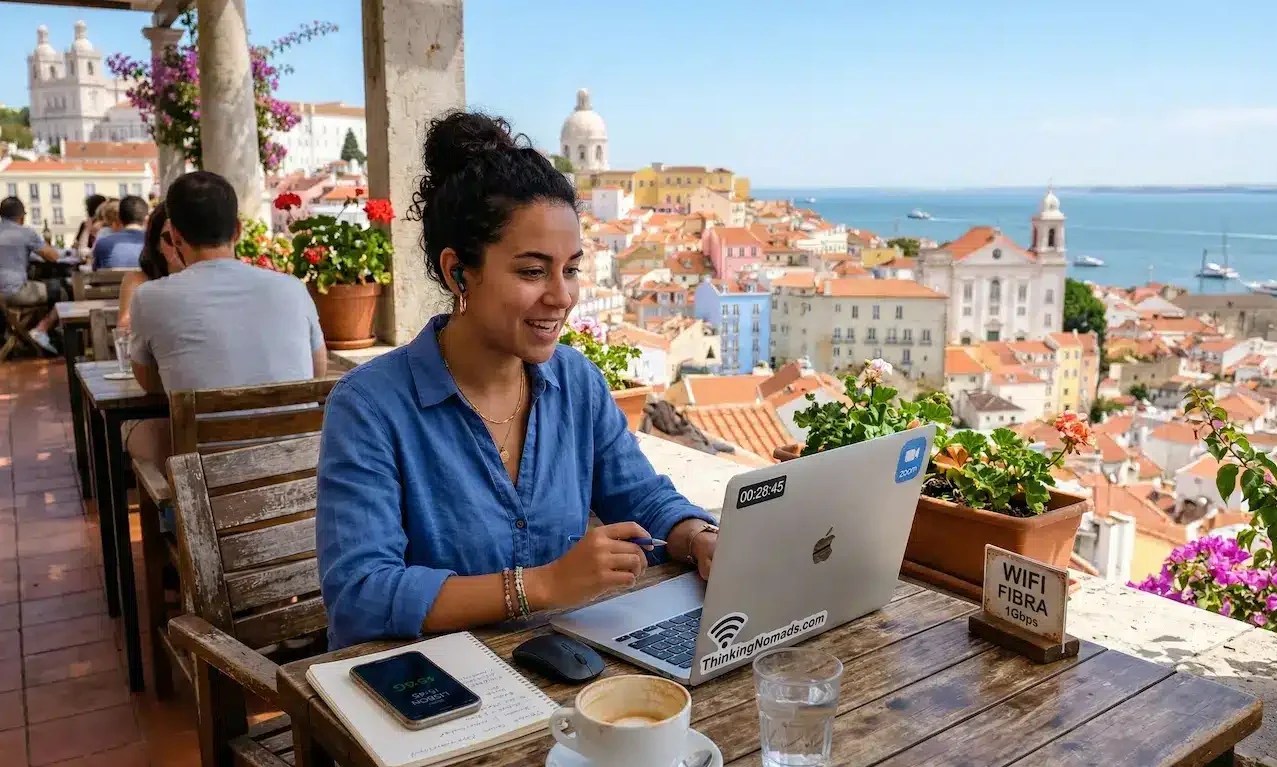
There is a gap between where digital nomads want to live and where they can reliably take a video call. That gap is narrowing, but it has not closed.
After three years of working remotely across Portugal, Spain, Greece, Croatia, and Italy, here is an honest connectivity report from the places that matter.
Portugal: The Benchmark
Portugal set the standard early. The government’s fibre rollout has been aggressive and effective – as of 2026, over 85 percent of Portuguese households have access to fibre broadband, including many rural areas. Lisbon and Porto routinely deliver 500 Mbps to 1 Gbps at residential connections. Even smaller cities like Braga, Coimbra, and Faro are well served.
The real test is the co-working spaces. Lisbon’s Second Home in Cais do Sodre and Porto’s UPTEC campus both offer dedicated fibre lines with 200+ Mbps symmetrical speeds. In the Algarve, Lagos Cowork and Faro’s Work & Surf deliver consistent connections.
Mobile coverage (4G/5G) is strong with NOS, MEO, and Vodafone. Dead zones exist in the mountainous interior – parts of the Serra da Estrela and upper Douro Valley can be patchy – but for anyone based in a town or city, connectivity is not an issue.
The weak spots: Madeira’s interior trails (obvious, but worth noting if you plan to work from a levada) and the Azores, where broadband speeds are improving but remain slower than the mainland average.
Immigration specialists at Global Citizen Solutions note that Portugal’s infrastructure investment has been a deliberate part of its strategy to attract remote workers – its digital nomad visa and the connectivity to support it were developed in parallel.

Spain: Excellent in Cities, Variable Elsewhere
Spain’s fibre coverage is among the best in Europe – the country actually leads the EU in fibre-to-the-home penetration. Madrid, Barcelona, Valencia, Seville, and Malaga are all excellent for remote work. Co-working spaces in these cities typically offer 300+ Mbps.
Where Spain stumbles is in the smaller towns that many nomads find most appealing. The white villages of Andalucia look spectacular on Instagram but some rely on ADSL connections that top out at 20 Mbps. The Canary Islands are better connected than you might expect (Tenerife and Gran Canaria both have good fibre coverage), but Lanzarote and Fuerteventura can be inconsistent outside main towns.
The Balearics are a mixed bag. Palma de Mallorca is well served. Rural Mallorca, Menorca, and Ibiza’s interior can struggle.
Top tip: check the Movistar or Orange coverage maps before booking accommodation anywhere outside a major city. The difference between two villages 10 kilometres apart can be dramatic.

Greece: The Beautiful Gamble
Greece is where connectivity becomes an adventure. Athens and Thessaloniki are fine – fibre is available in central areas, and speeds of 100-200 Mbps are standard. Crete’s north coast (Heraklion, Chania, Rethymno) is reasonably well connected.
The islands are a lottery. Mykonos and Santorini have invested in infrastructure because tourism demands it. Naxos, Paros, and Milos are improving. But smaller Cycladic islands (Serifos, Sifnos, Amorgos) and the Dodecanese can be genuinely challenging for anyone who needs to upload large files or maintain stable video calls.
The Greek solution is Starlink, which has seen rapid adoption among island-based nomads. Several co-working spaces and guesthouses on smaller islands have installed Starlink terminals, transforming previously unworkable locations into viable bases.
The Pelion peninsula on the mainland is a hidden gem – beautiful, affordable, and with surprisingly good COSMOTE fibre coverage in towns like Volos and Portaria.

Italy: North-South Divide, as Usual
Northern Italy is excellent. Milan, Turin, Bologna, and the Veneto region all have strong fibre infrastructure. Florence and Rome are solid. Co-working spaces in these cities compete with the best in Europe.
Southern Italy and the islands are where things get interesting. Naples itself is fine, but the Amalfi Coast’s geography (everything built on cliff faces) makes infrastructure deployment difficult. Sicily is improving rapidly – Palermo and Catania both have good fibre – but inland towns can still struggle.
Puglia is a particularly relevant case because it has become popular with nomads attracted by the trulli houses and low living costs. Lecce and Bari are well connected. Smaller towns like Ostuni and Alberobello are variable – check before committing to a month-long rental.
Sardinia’s connectivity follows the coast. Cagliari and Alghero are fine. The interior is patchy.

Croatia: Better Than Expected
Croatia surprised me. Zagreb has solid infrastructure, and the coast – Dubrovnik, Split, Zadar, Rovinj – has benefited from tourism-driven investment. Fibre availability in central Split is good, and several co-working spaces (including Rovinj’s creative hub in a converted tobacco factory) offer reliable connections.
The islands are the weak point, as in Greece. Hvar and Brac have basic coverage. Smaller islands may require a Starlink investment.

The Connectivity Checklist
Before committing to any location for a month or more:
- Check the ISP coverage map for the specific address (not just the town)
- Ask the landlord what speed they actually get, not what they are paying for
- Have a mobile data backup plan – buy a local SIM with a generous data allowance on arrival
- Test the connection during a video call before signing anything
- If the listing says “Wi-Fi available” and nothing more specific, be suspicious
- Co-working spaces are your insurance policy – even if you prefer working from home, know where the nearest one is
The Verdict by Country
- Best overall connectivity: Portugal (consistent, widespread, reliable)
- Best city connectivity: Spain (fastest average speeds in cities, weakest in rural areas)
- Most improved: Croatia (underrated and getting better fast)
- Best if you have Starlink: Greece (stunning locations become workable)
- Most variable: Italy (excellent north, lottery south)
The good news is that Southern Europe’s connectivity is improving faster than anywhere else on the continent. The places that were unworkable three years ago are often fine now. The places that were fine are often excellent. The direction of travel is clear – even if the upload speed on that beautiful Cycladic island is not quite there yet.

Lived in England since 1998 and travelled the world since 2005, visiting over 100 countries on 5 continents. Writer, blogger, photographer with a passion for adventure and travel, discovering those off beat places not yet on the tourist trail. Marco contributes the very best in independent travel tips and lifestyle articles.
